
NEMESIS / BIOSIGNAL ICs
Understand the signal. Choose the interface.
A focused view of biosignals and sensing interfaces, from measurement needs to a testable evaluation plan. Platinum Bio helps organize requirements and coordinate product information and technical discussions.
MODEL REFERENCE
Start with the actual model families.
| Model | Function | Application |
|---|---|---|
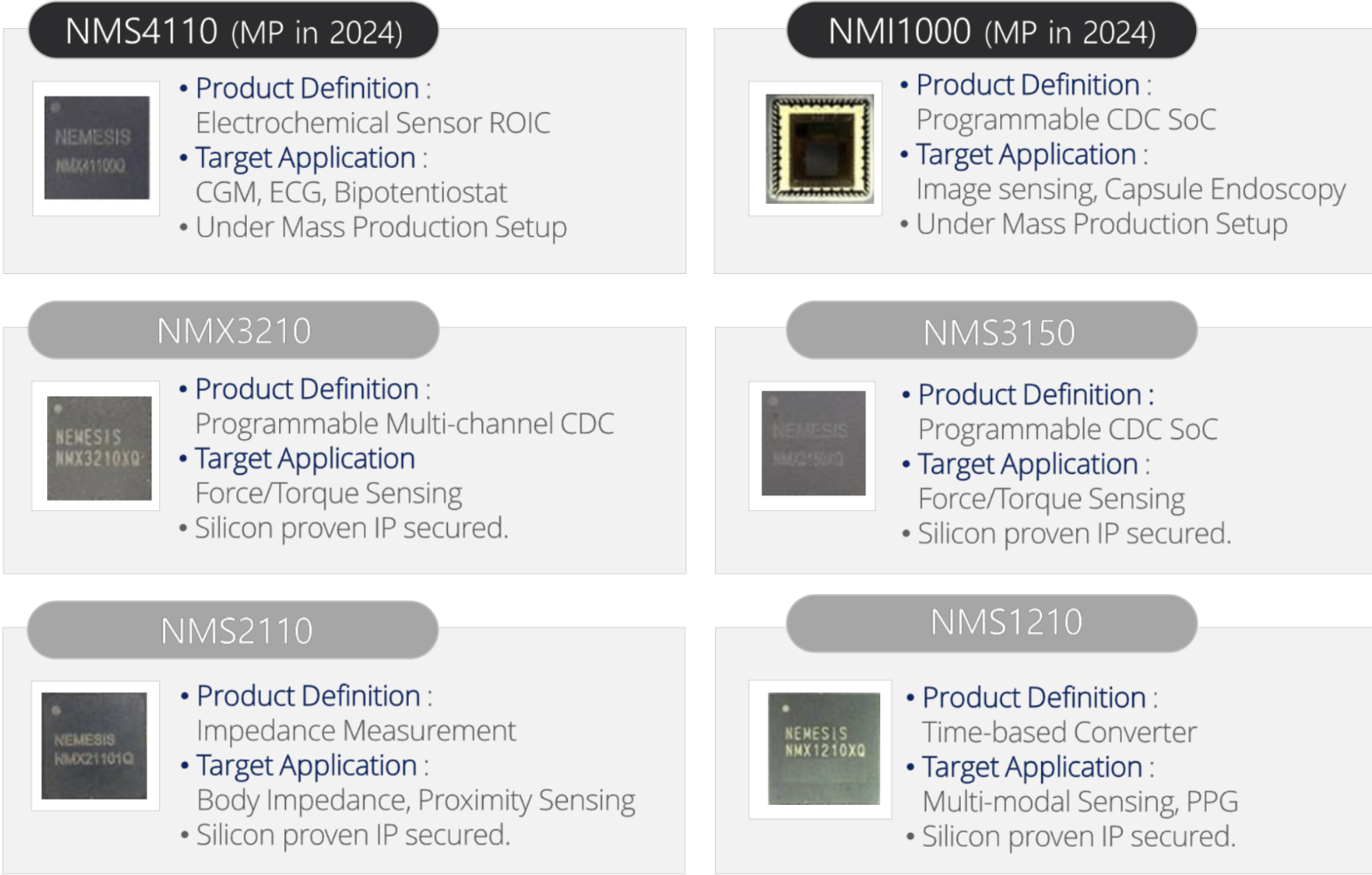
NMS4110 | Electrochemical sensor ROIC | CGM, ECG, bipotentiostat |
NMI1000 | Programmable CDC SoC | Image sensing, capsule endoscopy |
NMX3210 | Multi-channel CDC | Force and torque sensing |
NMS3150 | Programmable CDC SoC | Force and torque sensing |
NMS2110 | Bio-Z impedance IC | Body impedance, proximity sensing |
NMS1210 | Time-based converter | Multi-modal sensing, PPG |
Model positioning follows the existing Nemesis overview. 2024 is the original reference year; confirm current specifications, availability and evaluation tools.
Start with what you need to measure.
ECG, EEG, EMG and Bio-Z have different measurement architectures and requirements. Define the target signal and sensor or electrode arrangement before comparing product families.
- Signal amplitude and bandwidth
- Sensor or electrode configuration
- Channel count and measurement conditions
Then review the IC-to-system interface.
Front-end measurement capability is only the starting point. Review supply requirements, data output, power budget and size together rather than selecting on a single performance figure.
- Front-end and noise requirements
- Supply and power budget
- Data interface and system compatibility
Validate the fit through evaluation.
Share your platform, test plan and timeline. Platinum Bio can help confirm available documentation, evaluation tools and next discussions. Specifications and support scope are confirmed for the selected model with manufacturer information.
- Technical documents and revisions
- Sample and evaluation tool needs
- Test conditions and acceptance criteria
MODELS & NEXT STEPS
Next, review the model.
This page explains a general selection process. Individual ICs differ in sensing and processing capabilities; use model-specific documents and test conditions.
QUESTIONS & ANSWERS
Selection questions
Which sensing applications can Nemesis biosignal IC technologies support?
The technology portfolio covers Bio-Z impedance, ECG, EEG, EMG, PPG, and multimodal sensing. Model direction should be evaluated against signal type, channel count, power, size, and system architecture.
What should be defined before selecting an IC for a medical wearable?
Start with the electrode or sensor interface, signal amplitude and bandwidth, channel count, power budget, data output, product size, and validation requirements before prototype testing.
How does Bio-Z evaluation differ from ECG, EEG, or EMG?
Bio-Z focuses on impedance architecture and excitation or measurement conditions, while ECG, EEG, and EMG place more emphasis on low-level analog front ends, noise, bandwidth, and electrode configuration.
How does a Nemesis technical evaluation begin?
Share the application, sensing signal, channel and power requirements, product size, and current validation stage so the team can map product direction, technical data, and a PoC path.